Once a product leaves the factory, most manufacturers lose sight of it almost immediately. It gets billed to a distributor, and from there, what happens is largely a guess. An end-to-end traceability system exists to close that gap, giving manufacturers a continuous view of every unit as it moves from production all the way to the customer who finally buys it.
This guide explains what an end-to-end traceability system actually involves, how it works in practice, and why it’s become essential for manufacturers dealing with counterfeiting, channel opacity, and rising customer expectations around product authenticity.
What Is an End-to-End Traceability System?
An end-to-end traceability system is a structured way of tracking a product’s journey across every stage of the supply chain, from raw material and production, through distributors and dealers, to the final point of sale or use.
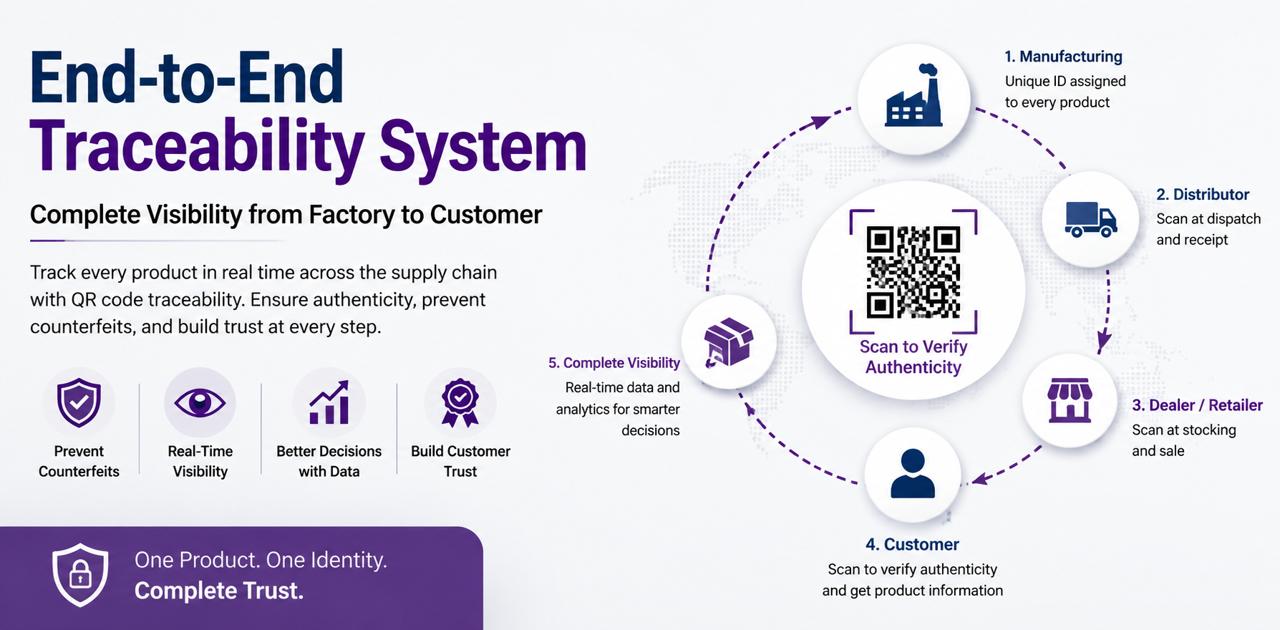
Unlike traditional tracking, which usually stops at the invoice, this approach follows the product itself using unique identifiers, most commonly QR codes, that get scanned at each handoff point. Every scan adds a data point: location, time, and often the identity of whoever scanned it. Over time, this builds a complete, verifiable record instead of a set of assumptions stitched together from dispatch paperwork.
A properly built traceability solution captures this data continuously and turns it into something manufacturers can actually act on, not just archive.
How Traceability Works From Factory to Customer
The process typically follows a consistent structure, regardless of industry:
1. Unique product identity is assigned at the point of manufacturing, usually through a QR code or serialized number printed or affixed to the product or packaging.
2. The code is scanned at each transition point, factory dispatch, distributor receipt, dealer stocking, and ideally, point of sale or customer verification.
3. Each scan generates an event capturing location, timestamp, and sometimes the scanning party’s identity.
4. Data flows into a central system, building a live picture of where every unit is, or has been, across the supply chain.
5. Analytics and alerts surface patterns, slow-moving regions, suspicious duplicate scans, or channel diversion, that would otherwise stay invisible.
This is where the difference between primary and secondary sales visibility becomes important. Primary sales tell you what you billed. Secondary sales visibility tells you what actually happened afterward, and that’s the layer most manufacturers are missing today.
The Role of Serialization and QR Code Traceability
Serialization, assigning a unique identity to each individual unit rather than a shared batch code, is the foundation an end-to-end traceability system is built on.
A QR code traceability system makes this practical at scale. Because QR codes can be scanned with any smartphone, no specialized hardware is required, verification becomes accessible to distributors, dealers, and even end customers. This is a meaningful shift from older serialization methods that required dedicated scanning equipment and were largely confined to warehouses and factories.
Unit-level serialization also means a manufacturer can answer very specific questions: Did this exact product reach its intended region? Has this code been scanned more than once, suggesting duplication? Does a product carrying this code even exist in production records at all?
Benefits for Manufacturers, Distributors, Dealers, and Consumers
Traceability creates value differently for each stakeholder in the chain.
● Manufacturers gain real visibility into secondary sales, sharper demand planning, and stronger evidence for reward fulfillment solutions that depend on verified sales data rather than self-reported figures.
● Distributors benefit from clearer accountability, reducing disputes over territory violations or stock diversion.
● Dealers gain from more accurate incentive tracking when reward calculations connect directly to verified product movement instead of manual reporting.
● Consumers gain the ability to verify a product’s authenticity instantly, building trust in categories where counterfeiting has historically been common.
How Traceability Helps Prevent Counterfeit Products
Counterfeit prevention in supply chain management is one of the most immediate, tangible benefits of end-to-end traceability. A counterfeit product simply cannot carry a valid code that matches genuine production records.
This makes a fake product detection system far more reliable than manual inspection or packaging checks, which counterfeiters have become increasingly skilled at replicating. When a code is scanned and doesn’t match a legitimate serial number, or has already been scanned elsewhere, it flags instantly rather than surfacing months later during a customer complaint or quality audit.
Importance of Product Authentication and Brand Protection
Beyond stopping counterfeits after the fact, a strong product authentication system protects brand reputation proactively. Customers who can verify authenticity at the point of purchase are less likely to associate quality issues, real or perceived, with a brand’s name.
For manufacturers operating in India’s fragmented retail landscape, where informal and grey-market channels are common, brand protection solutions India businesses trust need to combine authentication with genuine supply chain visibility, not treat them as separate initiatives.
Industries That Benefit From End-to-End Traceability
| Industry | Primary Traceability Need |
| FMCG | Combating counterfeiting in high-volume, fast-moving categories |
| Pharma | Patient safety and regulatory serialization compliance |
| Agriculture | Verifying genuine seeds, fertilizers, and crop protection products |
| Electrical | Tracking dealer movement across large distribution networks |
| Building Materials | Authenticating products at the point of contractor purchase |
| Consumer Goods | Connecting scans to loyalty and engagement programs |
| Automotive | Verifying genuine spare parts and components |
Key Features of an Effective Traceability Solution
Not every product traceability software platform is built for real-world channel complexity. Look for:
Unit-Level Serialization
Every product needs its own unique code, not a shared batch identifier, for precise tracking and authentication.
Multi-Tier Scan Capture
The system should track movement across distributor, dealer, and retailer layers, not stop at the first point of sale.
Offline Scanning Capability
Connectivity gaps in rural and semi-urban India mean the system needs to capture scans offline and sync automatically once connectivity returns.
Real-Time Alerts
Automated flags for duplicate or suspicious scans save teams from manually auditing large volumes of data.
Integration With Loyalty and Rewards
Traceability data becomes far more valuable when connected to a channel loyalty program, allowing rewards to be based on verified movement rather than self-reported claims.
Best Practices for Implementation
● Start with a pilot region or product line before scaling nationally, to catch friction points early.
● Involve distributors and dealers early, framing traceability around program benefits like faster payouts rather than surveillance.
● Tie scanning to an existing incentive, such as reward redemption, so compliance happens naturally.
● Plan for offline-first scanning, especially for rural and semi-urban markets.
● Review scan data regularly, not just during audits, so patterns get acted on while they’re still useful.
Why Choose Elevatoz Loyalty’s Traceability Solution
Elevatoz Loyalty builds traceability as part of a connected ecosystem rather than an isolated tool. Our traceability solution captures product-level visibility and secondary sales data, working alongside anti-counterfeiting systems and channel loyalty programs so manufacturers aren’t managing separate vendors for closely related problems.
Zentram.ai powers the intelligence layer behind this data, helping teams identify unusual scan patterns or regional slowdowns faster than manual review. With over 20 years of experience, documented across our case studies and research reports, Elevatoz has helped manufacturers across FMCG, agriculture, and building materials bring real visibility into supply chains that previously ran on assumptions.
Conclusion
An end-to-end traceability system does more than stop counterfeits, it gives manufacturers a genuine, verified view of what happens to their product after it leaves the factory. That visibility strengthens channel accountability, sharpens demand planning, and builds customer trust at the point of purchase.
If your supply chain visibility still stops at the invoice, it’s worth exploring what a connected traceability system can show you instead. Schedule a demo with Elevatoz Loyalty to see how an end-to-end traceability system could work across your channel.
FAQs
What is an end-to-end traceability system?
It’s a system that tracks a product’s journey from factory production through distributors, dealers, and ultimately the customer, using unique codes scanned at each stage.
How does an end-to-end traceability system prevent counterfeiting?
Since each product carries a unique, verifiable code tied to genuine production records, counterfeit products can’t match a valid code, making fakes easy to identify at the point of scan.
What role does serialization play in traceability?
Serialization assigns a unique identity to each individual unit, enabling precise tracking, authentication, and fraud detection that shared batch codes cannot provide.
Can traceability data integrate with dealer loyalty programs?
Yes, connecting traceability with loyalty programs allows reward calculations to rely on verified product movement instead of self-reported sales figures, reducing fraud significantly.
Which industries benefit most from end-to-end traceability?
FMCG, pharma, agriculture, electrical, building materials, consumer goods, and automotive all benefit, particularly where counterfeiting risk or multi-tier distribution is common.