Selling seeds, fertilizers, or crop protection products in India means selling through a dealer network that often knows the local farmer better than your own sales team does. Dealer loyalty programs exist because that relationship, between your brand and the retailer who actually recommends it at the counter, is where a season’s sales are won or lost.
This guide looks at why dealer loyalty programs matter specifically for seed and agri-input companies, the challenges unique to this category, and what separates a program dealers actually engage with from one they quietly tolerate.
What Makes Agri-Input Dealer Networks Different
Unlike categories such as electronics or building materials, agri-input sales are seasonal, weather-dependent, and heavily influenced by trust built over years, not just margins. A retailer in a small agricultural town often serves as an informal advisor to farmers, recommending products based on relationships as much as brand loyalty.
This makes dealer loyalty programs for agriculture fundamentally different from a typical B2B incentive scheme. Timing matters enormously, rewards need to land right before or during the sowing season, not months later. And because many dealers operate with thin margins and limited working capital, delayed payouts hurt far more than they would in higher-margin categories.
Benefits of Dealer Loyalty Programs for Seed and Agri-Input Companies
A well-structured dealer incentive program delivers a number of concrete advantages for this sector specifically:
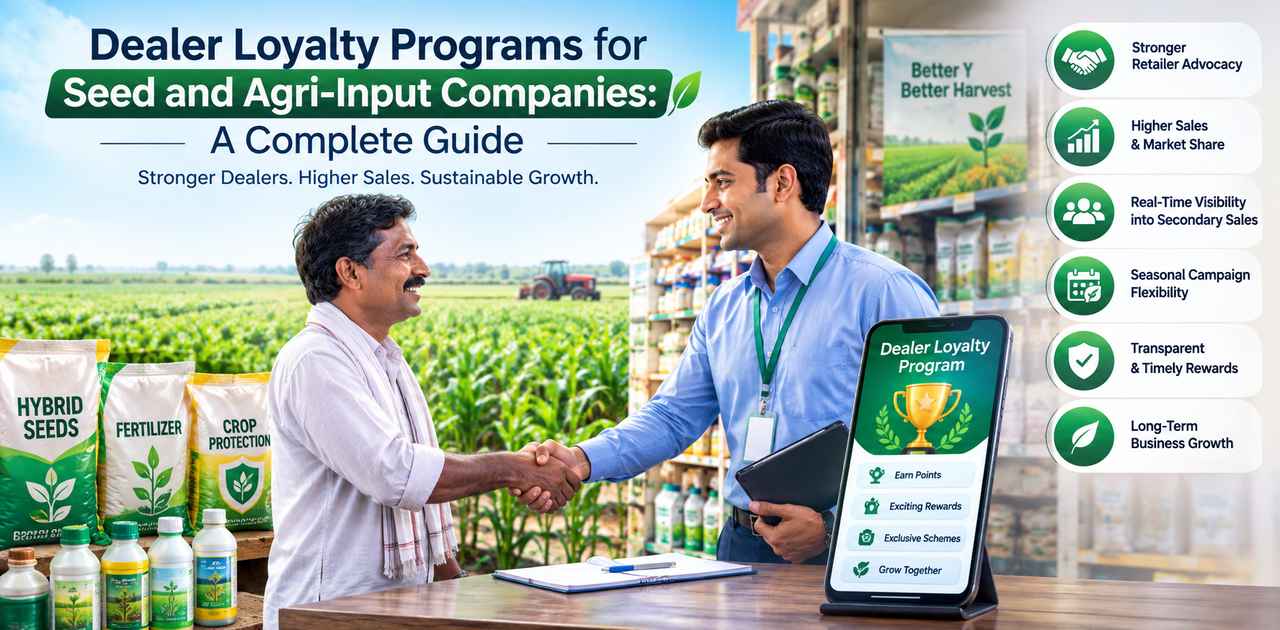
● Stronger retailer advocacy. Dealers who feel recognized and fairly rewarded are more likely to actively recommend your seed or fertilizer brand over a competitor sitting on the same shelf.
● Better visibility into secondary sales. Most agri-input companies only see what they billed to distributors, not what actually reached the retailer or the farmer. A connected channel loyalty platform helps close that gap.
● Improved seasonal planning. Real-time data on dealer participation helps regional teams anticipate demand and adjust incentive campaigns before the sowing window closes, not after.
● Reduced dependency on field staff memory. When incentive tracking lives in a system rather than a sales officer’s notebook, program continuity survives staff transfers and turnover.
● Higher trust in rural markets. Timely, transparent payouts build a reputation that travels fast within tightly connected dealer communities.
These benefits compound season after season, which is exactly why agri-input brands that invest early in structured dealer engagement tend to build a lasting edge over competitors still running manual schemes.
Common Challenges Faced by Agri Dealers
Before designing a program, it helps to understand what dealers themselves struggle with under typical manual systems:
Delayed and unclear payouts. Dealers frequently wait through an entire season, or longer, before receiving what they’ve earned, with little visibility into how the amount was calculated.
Confusing scheme structures. Multiple overlapping schemes from head office, sometimes changing mid-season, leave dealers unsure what they’re actually working toward.
Limited digital comfort. Many dealers in smaller towns are more comfortable with a phone call or a printed scheme sheet than a complex app, which vendors often overlook when designing their platforms.
Fragmented communication. Scheme updates arrive through a mix of WhatsApp messages, phone calls, and paper circulars, making it easy for dealers to miss important details.
Fraud and inflated claims. Manual verification makes it hard to catch duplicate billing or fake sales claims, particularly across a widely dispersed retailer base.
Weak feedback loops. Dealers rarely have an easy way to flag disputes or ask questions about their point balance, which quietly erodes trust over time.
Essential Features of an Effective Dealer Loyalty Program
Not every loyalty management software India platform is built with agri-input realities in mind. Here’s what actually matters for this category.
Simple, Mobile-First Dealer Access
Given the digital comfort levels common across rural retail networks, the dealer-facing app or portal needs to be simple enough to use with minimal training, checking points, viewing schemes, and browsing rewards should feel effortless.
Seasonal Campaign Flexibility
The platform should support quick, targeted campaigns tied to sowing and harvest cycles, rather than requiring a lengthy setup process every time a new scheme needs to launch.
Multi-Language Support
A dealer in Punjab and a dealer in Andhra Pradesh may both prefer transacting in their regional language. This single feature often determines adoption more than any other in agri-focused rollouts.
Automated, Transparent Payouts
Reward calculation and disbursal should happen automatically based on verified sales data, with dealers able to see exactly how their points were earned.
Traceability and Fraud Control
Given how easily manual claims can be manipulated, pairing loyalty management with traceability systems gives agri-input companies visibility into product movement beyond primary billing, while anti-counterfeiting systems help protect against spurious or duplicated products entering the channel, a persistent risk in agri categories.
Influencer and Field Staff Engagement
In many agri markets, local agronomists, retailers’ sales staff, or crop advisors influence buying decisions as much as the dealer themselves. Structured influencer engagement programs extend recognition to these ground-level voices too.
| Feature | Manual/Traditional Approach | Structured Dealer Loyalty Program |
| Payout timing | End of season, often delayed | Aligned to sowing/harvest cycles |
| Communication | WhatsApp, phone calls, paper | Automated notifications and portal updates |
| Fraud control | Difficult to verify manually | Data-backed validation and traceability |
| Language support | Limited, mostly English/Hindi | Multi-language dealer interfaces |
| Reporting | Delayed, regional office dependent | Real-time dashboards |
Best Practices for Successful Implementation
Even a well-designed program can underperform if the rollout is rushed. Keep these practices in mind:
● Time your launch around the crop calendar, not the financial year, so incentives land when dealers are actively making stocking decisions.
● Train field staff first. Regional sales officers are usually the trusted bridge between the platform and the dealer, so their buy-in shapes adoption more than any app feature.
● Start with a pilot region before a national rollout, so you can fix friction points on a smaller scale first.
● Keep scheme rules simple and communicate them clearly and repeatedly, rather than assuming one circular is enough.
● Review performance data after each season, not just at year-end, so the program keeps improving cycle over cycle.
Why Choose Elevatoz Loyalty
Elevatoz Loyalty brings together channel loyalty, traceability, anti-counterfeiting, and influencer engagement into one connected ecosystem, which matters in agri categories where all four concerns often show up together. The platform’s channel loyalty solution supports program design, dealer activity tracking, and automated reward execution without forcing agri-input companies to stitch together separate tools.
Behind the scenes, Zentram.ai applies intelligence to participation data, helping regional teams spot dealer disengagement or unusual claim patterns before they become costly problems, particularly useful given how thin margins and seasonal cash flow work in agriculture.
With over 20 years of experience helping enterprises build stronger channel ecosystems, detailed in our case studies and research reports, Elevatoz understands what makes rural dealer engagement genuinely work, not just look good on paper. Many of these lessons echo what we’ve documented in our guide on designing a dealer loyalty program that actually retains partners.
Conclusion
Dealer loyalty programs aren’t a nice-to-have for seed and agri-input companies, they’re often the deciding factor in whether a retailer pushes your brand or a competitor’s when a farmer asks for a recommendation. Getting the timing, transparency, and simplicity right matters more in this category than almost any other.
If your current dealer engagement still runs on phone calls and paper schemes, it’s worth exploring what a connected, season-aware platform can do differently. Schedule a demo with Elevatoz Loyalty to see how a modern dealer loyalty program could work for your agri-input business.
FAQs
What are dealer loyalty programs in agriculture?
They are structured incentive systems that reward agri-input dealers and retailers for consistent stocking, sales performance, and brand advocacy, replacing informal or manual scheme tracking.
Why do seed and agri-input companies need dealer loyalty programs?
Rural dealer networks are relationship-driven and seasonal, so a structured program builds trust, ensures timely payouts, and keeps retailers actively recommending the brand during critical sowing windows.
What features matter most in an agri dealer loyalty platform?
Mobile-first access, multi-language support, seasonal campaign flexibility, and automated transparent payouts tend to matter most, given the realities of rural retail networks.
How can agri-input companies prevent dealer fraud in loyalty programs?
Pairing dealer loyalty programs with traceability and verification systems helps validate claims against actual product movement, reducing duplicate or inflated sales claims.
How does Elevatoz Loyalty support agri-input dealer engagement?
Elevatoz Loyalty combines channel loyalty, traceability, anti-counterfeiting, and influencer engagement into one platform, backed by AI-driven insights through Zentram.ai and two decades of program execution experience.