Introduction:
Why Traditional B2B Loyalty Programs Need a Smarter Approach
A manufacturer can have thousands of registered dealers and still know surprisingly little about the health of those relationships. Some partners earn points but rarely redeem them. Others buy steadily until orders suddenly slow. A regional manager might notice the decline, but only after a competitor has gained ground. The problem is not a lack of loyalty schemes. It is the gap between collecting channel activity and acting on it in time.
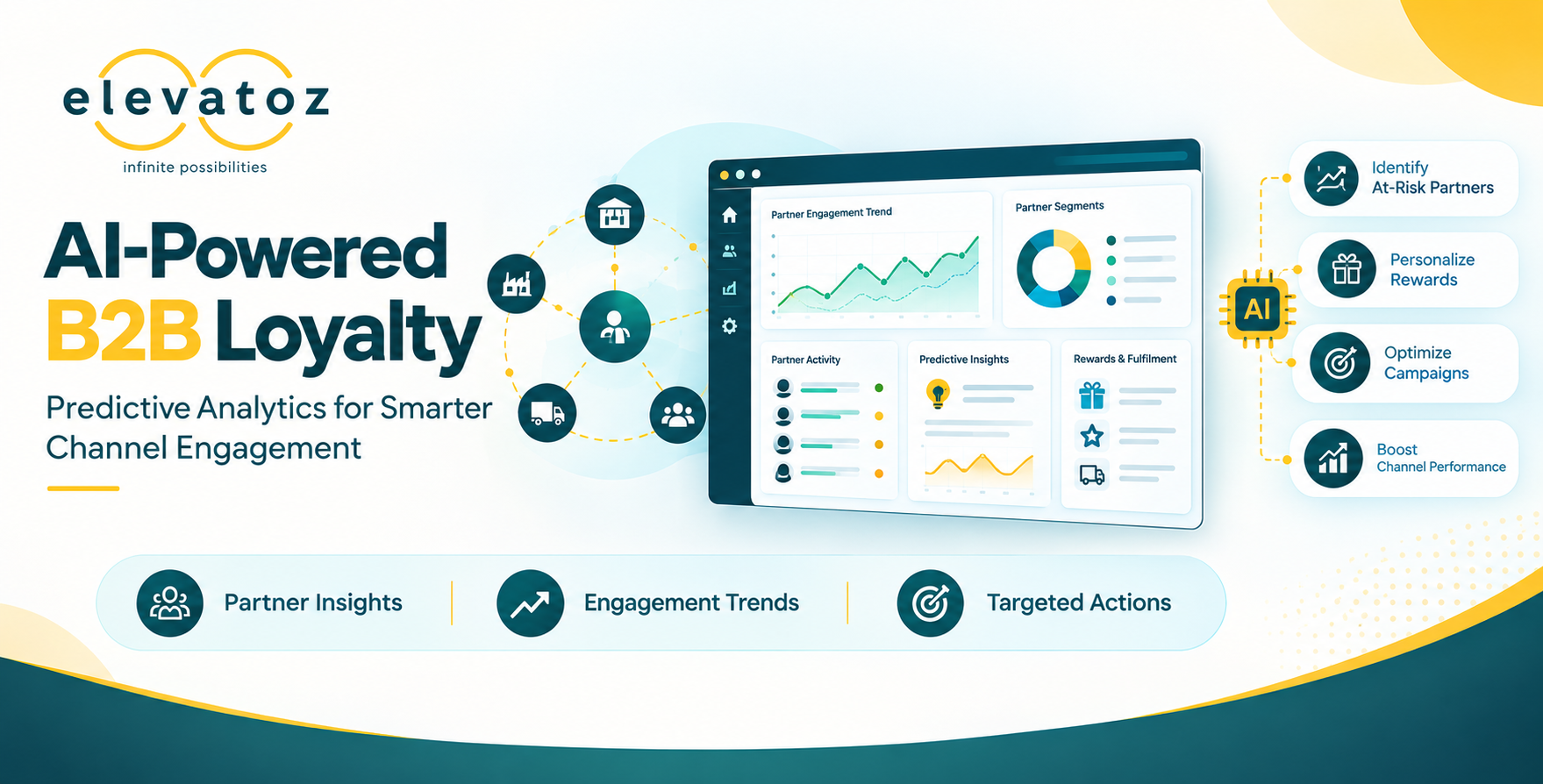
An AI-powered B2B loyalty platform can help close that gap by combining reliable activity records with analytics that highlight changes in partner behaviour. Instead of sending every dealer the same offer, teams can investigate who needs attention, which rewards matter and whether an intervention actually changes outcomes. This article explores the practical opportunities, the data required and the limits that responsible managers should understand before investing.
What Is an AI-Powered B2B Loyalty Platform?
A B2B loyalty platform is a system for enrolling channel partners, defining earning rules, validating eligible activity, communicating offers, managing rewards and reporting program results. Participants might include distributors, dealers, retailers, mechanics or contractors. An AI-enabled layer adds segmentation, pattern recognition or predictive models to help interpret that activity.
Traditional points systems answer a narrow question: how many points has a partner earned? Data-informed systems can also ask whether participation is changing, whether rewards are being claimed, which cohorts respond to a campaign and where manual intervention is needed. The distinction matters because a dealer relationship is not a consumer checkout transaction. It involves credit terms, territory conditions, product availability, field sales support and sometimes multiple people influencing one purchase. Analytics should inform these relationships, not replace them.
How Predictive Analytics Could Change Channel Engagement in 2027
Predictive analytics examines historical and current signals to estimate what may happen next. A model might flag a retailer whose scan activity has fallen for several weeks, identify a distributor whose purchase mix is shifting or estimate which partner segments are more likely to respond to training than a discount. These are probabilities, not explanations or guarantees.
Looking toward 2027, the useful shift is from periodic retrospective reports to more timely, testable decisions. A regional team could receive a prioritized list of accounts to review rather than a spreadsheet of all accounts. A program manager could compare campaign response across segments instead of assuming that a national offer works equally well everywhere. Such benefits depend on consistent identity records, sufficient history, validated events and regular model checks. Seasonality, stockouts and territory changes can make an apparently alarming pattern perfectly normal.
Five Ways AI-Powered Loyalty Platforms Improve Partner Engagement
Early Identification of At-Risk Channel Partners
Declining verified purchases, fewer app visits or reduced reward claims may indicate disengagement. A sensible workflow flags the change, compares it with similar partners and asks a field representative to verify the reason. The partner might need product availability, payment support or a simpler redemption process rather than another incentive.
More Relevant Rewards and Incentives
Partners have different economics. A high-volume distributor may value predictable settlement, while a smaller retailer may respond to achievable milestones or useful business support. Behavioural segmentation can help teams test alternative rewards, but fairness, transparent eligibility and budget limits remain essential. Avoid assuming that the reward with the most redemptions generated the most incremental sales.
Smarter Campaign Timing and Communication
A dealer who ignores long emails might respond to a concise WhatsApp update, while another may prefer contact from a field representative. Past engagement can guide timing and channel selection. Teams should respect communication preferences and measure meaningful responses rather than message delivery alone.
Improved Sales and Channel Performance Visibility
Verified scans, partner activity and product movement can reveal where participation is strengthening or weakening. These signals are especially useful when primary billing says little about secondary sales. However, scan data is not automatically a complete sales ledger: missing scans, shared devices and inconsistent reporting can distort the picture.
Better Budget Allocation and ROI Measurement
Instead of rewarding all participants identically, managers can test focused interventions and compare incremental results against their cost. A control group or credible baseline is more informative than raw participation growth. Reward costs, fulfilment expenses, platform fees and field effort should all enter the calculation.
Practical Example: Predictive Analytics in a Manufacturer’s Dealer Network
Hypothetical example: An electrical products manufacturer notices that verified participation has declined among dealers in two districts. An analytics system flags the drop, and the channel team compares it with neighbouring districts and the same season last year. Field calls reveal two distinct causes: one area experienced delayed stock replenishment; another had confusion over a new reward rule.
The manufacturer addresses stock availability in the first area and provides targeted rule explanations in the second. It then monitors active-partner rate and repeat ordering against a comparable group. The lesson is not that AI diagnosed the problem. It identified where investigation could begin. Human verification turned the signal into a sensible response.
What Data Does a B2B Loyalty Platform Need?
Useful inputs include validated transactions and scans; enrolment and partner identifiers; reward earning and redemption history; campaign responses; product and territory information; field activity; and relevant service complaints. Teams need clear definitions for an active partner, a completed sale and a valid redemption. Duplicate identities and delayed feeds can undermine otherwise sophisticated analysis.
Data governance is equally important. Collect only information needed for a defined purpose, communicate how it will be used, restrict access by role, set retention rules and assess applicable privacy obligations. Where data from different systems is combined, audit trails and reconciliation processes help prevent false signals from driving unfair decisions.
How to Measure the Impact of Predictive Analytics on Channel Loyalty
Start with a specific hypothesis: for example, targeted follow-up to previously active but declining dealers will increase reactivation relative to usual outreach. Define the eligible cohort and measurement window before launching. Track active-partner participation, repeat purchase frequency, reactivation, campaign conversion, verified secondary sales where available and reward cost per incremental outcome.
A simple ROI view compares incremental contribution attributable to the intervention with all associated costs. Revenue uplift alone is not profit, and a correlation between high engagement and high sales does not prove the loyalty program caused the sales. Controlled pilots, matched groups or staggered rollouts provide stronger evidence than a before-and-after dashboard.
How to Choose the Right B2B Loyalty Platform for 2027
Evaluate whether the system supports flexible tiers and reward rules, verified event capture, reliable integrations, partner segmentation, multilingual communication, role-based dashboards, fulfilment operations and audit-ready reporting. Ask how duplicate scans and disputed claims are handled. Request a demonstration using realistic data from your distribution model rather than a generic dashboard.
If predictive analytics is a requirement, ask the vendor which models are actually deployed, what input data they require, how predictions are validated and whether a human can review recommendations. An AI label is not proof of a mature forecasting capability. Also examine implementation ownership, partner support, data portability, security and total operating cost.
How Elevatoz Loyalty Supports Smarter Channel Engagement
Elevatoz Loyalty describes a connected ecosystem spanning channel loyalty, traceability, anti-counterfeiting, influencer engagement, analytics and fulfilment. Its channel loyalty solution covers program design, partner activity tracking and execution workflows, including communication and rewards. The company also describes Zentram.ai as an operating layer for configuration, governance, dashboards, segmentation and pattern analysis. Its public Zentram.ai page refers to predictive modelling and drop-off prediction, although a buyer should verify the exact available functionality, data prerequisites and implementation scope during a demonstration.
For manufacturers with fragmented dealer networks, this combination offers a relevant starting point for discussing verified participation and more informed channel action. Explore the company’s channel loyalty and Zentram.ai pages, then request a tailored demonstration to evaluate fit for your industry and operating model.
Conclusion:
Predictive analytics will not repair weak dealer relationships by itself. It can, however, help channel teams notice changes earlier, direct attention more carefully and learn which interventions produce measurable results. A capable B2B loyalty platform connects that intelligence to dependable onboarding, verification, rewards and field execution. For 2027 planning, begin with one high-value use case, establish trustworthy data and measure outcomes before scaling. That is a more sustainable path than adding AI features without a clear business decision to improve.
Frequently Asked Questions
What is a B2B loyalty platform?
It is software for managing channel partner enrolment, eligible activity, incentives, rewards, communication and performance reporting. It helps manufacturers coordinate structured programs across dealers, distributors, retailers and other participants rather than relying only on manual schemes.
How does predictive analytics improve channel partner engagement?
It identifies patterns in verified participation and transaction data that may help teams prioritize follow-ups, tailor campaigns and test reward designs. Predictions should be reviewed alongside field feedback and operational conditions before action is taken.
Can AI predict dealer disengagement?
Models can estimate disengagement risk from past and current activity when sufficient reliable data exists. They cannot determine the underlying cause with certainty. Stock availability, seasonality, local competition and service issues still require investigation.
What data is required for AI-powered loyalty programs?
Typical inputs include verified transactions, scan events, partner profiles, campaign responses, reward history and product or territory information. Accurate identities, permissions, consistent definitions and suitable data governance are essential for useful analysis.
How can businesses measure B2B loyalty program ROI?
Measure incremental contribution against reward, technology, fulfilment and operating costs. Track participation and retention as supporting metrics, and use comparison groups or credible baselines wherever possible to distinguish program impact from unrelated sales changes.
What should businesses look for in a B2B loyalty platform in 2027?
Prioritize flexible program rules, activity validation, reliable integrations, analytics, partner-friendly communication, transparent fulfilment and security. If predictive AI matters, request evidence of the specific models, data requirements, accuracy checks and operational support available.