Most manufacturers know exactly what leaves their factory. Far fewer know what happens after that, which distributor it passed through, which dealer stocked it, or whether it even reached the market it was meant for. QR code traceability for manufacturers exists to close that gap, giving every unit a digital identity that can be tracked well beyond the invoice.
This guide walks through how QR code traceability actually works, why product identity and serialization matter more than most manufacturers realize, and how visibility into secondary sales changes the way channel programs, fraud prevention, and dealer engagement all function together.
What Is QR Code Traceability and How Does It Work?
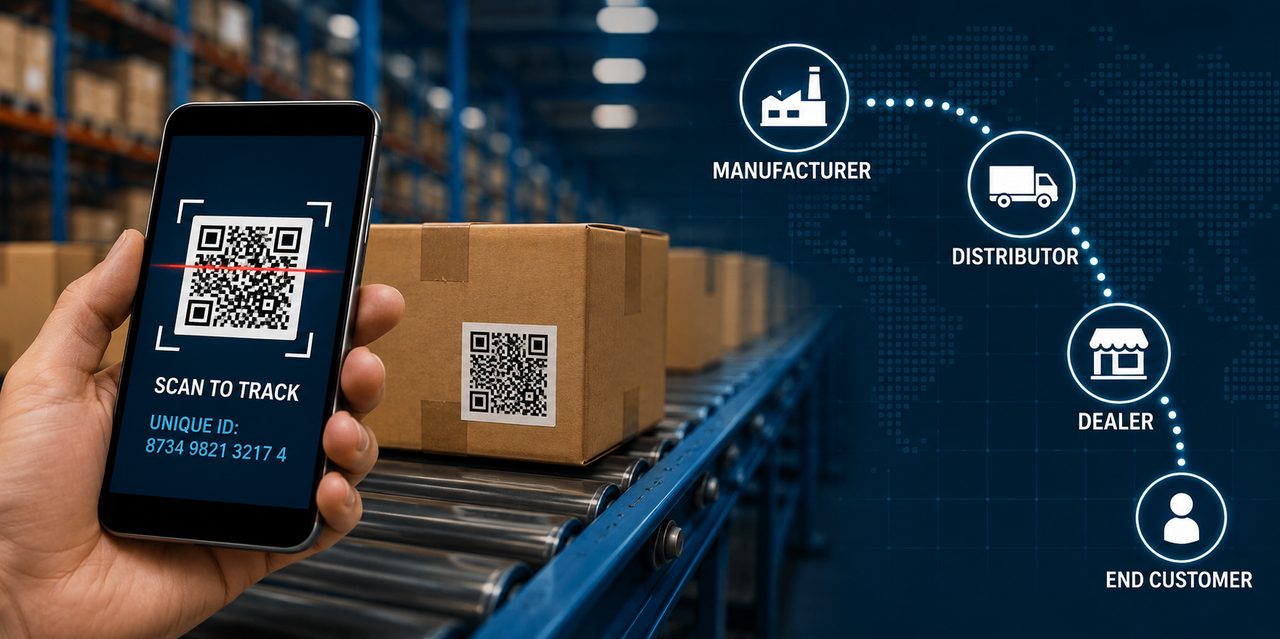
QR code traceability is the practice of assigning a unique, scannable code to each product unit or batch, then tracking that code as it moves through the supply chain, from production to distributor, to dealer, and ideally to the end customer.
Each scan generates an event: who scanned it, where, and when. Over time, these events build a data trail that shows exactly how a product actually travels, rather than relying on what invoices and dispatch records claim happened. A properly implemented traceability system captures this data continuously, feeding it into dashboards that sales, marketing, and quality teams can all use differently.
Unlike older tracking methods, batch numbers stamped on packaging, for instance, QR codes are unique at the unit level and can be verified instantly using any smartphone, no special scanner required. That accessibility is precisely what makes the approach practical at scale across large, geographically spread dealer networks.
Why Product Identity and Serialization Matter
Serialization, giving every single unit its own unique identifier rather than a shared batch code, is the foundation everything else in this guide builds on.
Without unit-level identity, a manufacturer can only ever know things in aggregate: how many units left the factory, how many were billed to a distributor. With serialization, you can answer far more specific questions. Did this exact unit reach the region it was meant for? Is this the same product being resold through a grey-market channel? Has this code already been scanned somewhere else, suggesting duplication or counterfeiting?
This level of specificity is also what makes anti-counterfeiting systems effective. A counterfeit product simply won’t carry a valid, unique code that matches your production records, making detection straightforward at the point of verification rather than after the damage is done.
How QR Codes Improve Supply Chain Transparency
Supply chain transparency isn’t just a compliance buzzword, it’s the difference between reacting to problems after they’ve cost you money and catching them early.
QR code scans, aggregated across thousands of products and touchpoints, reveal patterns that were previously invisible:
● Which regions are seeing unusually slow product movement, suggesting oversupply or weak dealer engagement.
● Which distributors are diverting stock outside their designated territory.
● Where counterfeit or duplicate codes are appearing, and how frequently.
● How long, on average, product sits at each stage before reaching the end customer.
None of this requires guesswork once the data is flowing consistently. It simply requires a system built to capture, structure, and present it in a usable way.
Benefits of Secondary Sales Visibility for Manufacturers
Primary sales data, what you billed to a distributor, tells you very little about actual market performance. Secondary sales visibility, tracking movement from distributor to dealer and beyond, is where the real business insight lives.
Accurate demand sensing. You can see where product is actually selling through, not just where it was shipped, which sharpens production and distribution planning.
Stronger channel accountability. Distributors and dealers who know their activity is visible tend to behave more consistently, reducing diversion and underreporting.
Better-informed [dealer loyalty software](https://elevatozloyalty.com/our-solutions/channel-loyalty) decisions. Reward programs built on verified secondary sales data are far harder to manipulate than ones relying on self-reported figures.
Faster fraud detection. Suspicious scan patterns, the same code appearing in two distant locations, for example, surface quickly rather than months later during an audit.
Improved regional strategy. Manufacturers can identify underperforming territories and adjust channel incentive management strategies before an entire selling season is lost.
Real-World Use Cases Across Industries
QR code traceability isn’t limited to any single sector. Here’s how it plays out differently across categories.
FMCG brands use traceability to combat counterfeiting on fast-moving, high-volume products where fake versions can spread through informal retail before anyone notices.
Agriculture and agri-inputs companies rely on it to verify that seeds, fertilizers, and crop protection products reaching farmers are genuine, particularly given how counterfeit agri-inputs can directly damage crop yields.
Pharma manufacturers use serialization largely for patient safety and regulatory compliance, ensuring medicines can be verified at the point of dispensing.
Electrical goods companies use traceability to track dealer and distributor movement across large networks where product substitution risk is high.
Building materials brands, cement, tiles, paints, use it to verify authenticity at the point of purchase, where contractors and masons often make real-time brand decisions.
Consumer goods companies use QR-based tracking to connect product movement data with loyalty and rewards programs, turning a simple scan into both a verification step and an engagement touchpoint.
Key Features to Look For in a QR Code Traceability Solution
Not every track and trace software platform is built with the same rigor. Here’s what genuinely matters:
Unique Unit-Level Serialization
Every product should carry its own code, not a shared batch identifier, to enable precise tracking and authentication.
Real-Time Scan Data Capture
Scans should feed into dashboards immediately, not through delayed batch uploads, so anomalies can be caught while they’re still actionable.
Multi-Tier Visibility
The system needs to track movement across distributor, dealer, and retailer layers, not just the first point of sale.
Offline Scanning Support
Given connectivity gaps in rural and semi-urban India, the solution should still capture scans offline and sync once connectivity returns.
Fraud and Duplication Alerts
Automated flags for repeated or suspicious scans save teams from manually combing through data to catch problems.
Analytics and Reporting
Raw scan data is only useful when it’s translated into clear reporting that sales and marketing teams can actually act on.
Integration With Dealer Loyalty, ERP, and CRM Systems
Traceability data becomes significantly more valuable when it doesn’t sit in isolation. Connecting it to a channel loyalty platform allows reward calculations to be based on verified movement rather than self-reported sales figures, closing a major fraud loophole in most B2B loyalty software.
Integration with ERP systems ensures traceability data aligns with actual production and dispatch records, while CRM integration connects scan-based insights with the sales team’s existing view of dealer and distributor relationships. Categories that rely heavily on field influencers, contractors, electricians, agronomists, also benefit from linking traceability with influencer engagement programs, since ground-level participation often correlates closely with genuine product movement.
Common Implementation Challenges and Best Practices
Rolling out QR code traceability isn’t purely a technology exercise, and a few recurring challenges are worth planning for early.
Dealer and distributor resistance. Some channel partners worry traceability means closer scrutiny of their operations. Framing the rollout around program benefits, faster payouts, fraud protection, tends to ease this friction.
Inconsistent scanning behavior. If scanning isn’t built into an existing workflow, like reward redemption or invoice verification, it often gets skipped. Tying scans to a clear incentive improves compliance.
Connectivity limitations. Rural markets need offline-capable scanning, not just a mobile-friendly interface that assumes constant connectivity.
Data overload without action. Capturing scan data is only half the job. Teams need clear dashboards and alerts, not raw exports that nobody reviews regularly.
Phased rollout works better than a big-bang launch. Piloting in one region or product line first helps identify friction points before scaling nationally.
Why Manufacturers Choose Elevatoz Loyalty
Elevatoz Loyalty treats traceability as part of a connected ecosystem rather than a standalone tool. The platform’s traceability solution captures product-level visibility and secondary sales data, while working alongside anti-counterfeiting systems and channel loyalty programs so manufacturers aren’t stitching together separate vendors for related problems.
Zentram.ai powers the intelligence layer behind this data, helping teams spot unusual scan patterns, regional slowdowns, or channel diversion faster than manual review ever could.
Backed by more than 20 years of experience and outcomes documented across our case studies and research reports, Elevatoz has worked with manufacturers across FMCG, agriculture, building materials, and electricals to bring product-level visibility into channel programs that previously ran on trust alone.
Conclusion
QR code traceability for manufacturers isn’t just about stopping counterfeits, it’s about finally seeing what happens to your product after it leaves the factory. That visibility strengthens dealer accountability, sharpens demand planning, and makes every loyalty rupee spent easier to justify with real data.
If your business still relies on invoices and assumptions to understand secondary sales, it’s worth exploring what a connected traceability system can show you instead. Schedule a demo with Elevatoz Loyalty to see how QR code traceability could work across your channel.
FAQs
What is QR code traceability for manufacturers?
It’s a system that assigns a unique scannable code to each product unit, allowing manufacturers to track its movement from production through distributors, dealers, and ultimately the end customer.
How does QR code traceability help prevent counterfeiting?
Since each code is unique and tied to verified production records, counterfeit products can’t carry a matching valid code, making fake products easy to identify at the point of scan.
What is secondary sales visibility and why does it matter?
Secondary sales visibility tracks product movement beyond the initial distributor billing, showing manufacturers what actually reaches dealers and end customers rather than just what was invoiced.
Can QR code traceability integrate with dealer loyalty programs?
Yes, integrating traceability with dealer loyalty programs allows reward calculations to be based on verified product movement instead of self-reported sales data, reducing fraud significantly.
Which industries benefit most from QR code traceability?
FMCG, agriculture, pharma, electrical goods, building materials, and consumer goods all benefit, particularly in categories with high counterfeiting risk or complex multi-tier distribution networks.