
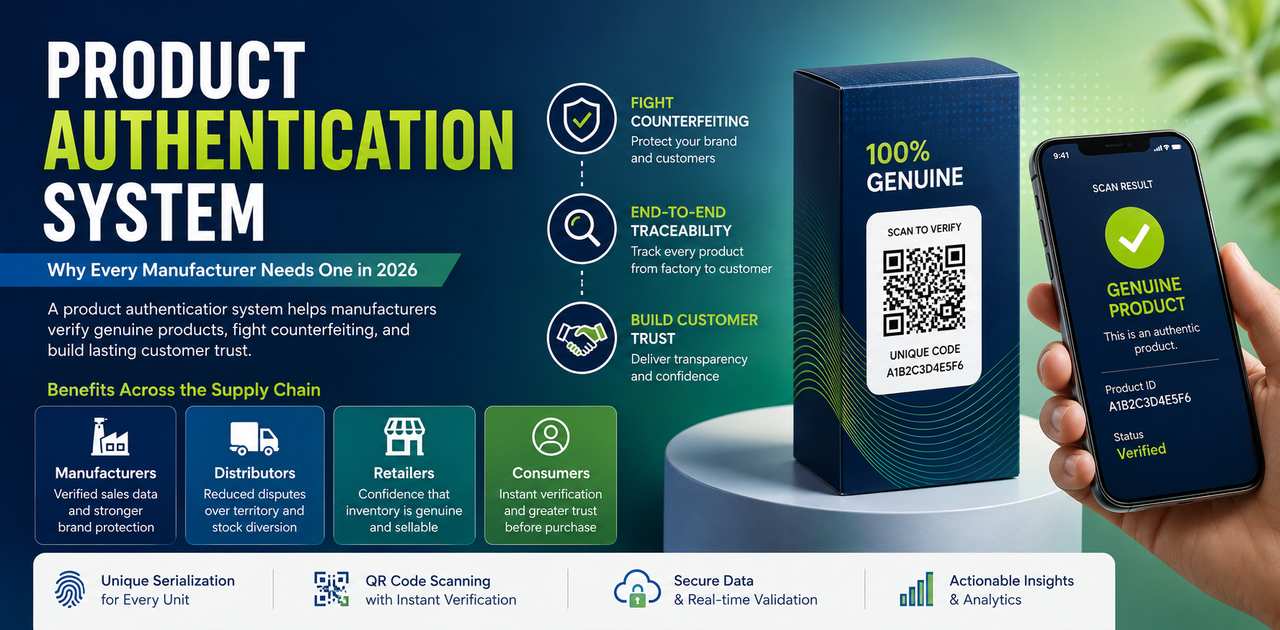
Counterfeiters have never had it easier. Packaging is simple to replicate, informal retail channels are everywhere, and customers increasingly shop through platforms where verifying authenticity is genuinely difficult. A product authentication system exists precisely for this reality, giving manufacturers a reliable way to confirm that what reaches a customer is exactly what left the factory.
This guide looks at why product authentication has become a genuine business priority in 2026, how the underlying technology works, and what manufacturers should look for before choosing a solution.
What Is a Product Authentication System?
A product authentication system allows a manufacturer, distributor, retailer, or customer to verify that a product is genuine, usually by scanning a unique code printed on the packaging and checking it against secure production records.
Rather than relying on packaging design or holograms, which counterfeiters have become skilled at replicating, a modern product authentication system ties each unit to a digital identity created at the point of manufacturing. If the code doesn’t match a legitimate record, or has already been used elsewhere, the system flags it instantly.
This shifts authentication from a visual judgment call to something verifiable in seconds, which matters enormously as counterfeiters get better at copying appearance without ever touching the underlying data.
Why Counterfeit Products Are Increasing in 2026
A few converging trends explain why counterfeit prevention in supply chain management has become more urgent rather than less.
● E-commerce and quick-commerce growth have made it easier for counterfeit sellers to reach customers directly, often bypassing the scrutiny of traditional retail.
● Cheaper printing and packaging technology means replicating a brand’s look no longer requires significant investment or expertise.
● Fragmented, multi-tier distribution networks, especially common in India, create more handoff points where genuine product can be swapped or diluted with fakes.
● Rising brand value awareness among counterfeiters means popular, trusted brands are targeted more aggressively, precisely because customers trust them.
None of these trends are going away on their own. They’re structural shifts in how goods move and how customers shop, which is exactly why relying on packaging alone is no longer a sufficient defense.
How QR Code Authentication and Serialization Work
The foundation of modern product authentication rests on two related ideas: serialization and QR code scanning.
Serialization means assigning a unique identifier to every individual unit, not a shared code across an entire batch. This is what makes verification meaningful at the unit level rather than only in aggregate.
A QR code traceability system makes this practical at scale, since any smartphone can scan a code instantly, no specialized hardware needed. Each scan is checked against secure production data, and the result, genuine, already used, or unrecognized, is returned immediately.
This same infrastructure often supports broader supply chain visibility too. An end-to-end traceability system doesn’t just authenticate a single unit, it tracks that unit’s movement from factory to distributor to dealer, giving manufacturers a continuous record rather than a single verification event.
Benefits for Manufacturers, Distributors, Retailers, and Consumers
Product authentication delivers different value depending on where you sit in the supply chain.
| Stakeholder | Key Benefit |
| Manufacturers | Verified secondary sales data and stronger brand protection |
| Distributors | Reduced disputes over territory and stock diversion |
| Retailers | Confidence that stocked inventory is genuine and sellable |
| Consumers | Instant verification and greater trust before purchase |
For manufacturers specifically, authentication data also strengthens reward fulfillment solutions tied to channel loyalty programs, since rewards can be calculated against verified, genuine sales rather than self-reported figures that are easier to manipulate.
How Authentication Improves Brand Protection and Customer Trust
Brand protection isn’t just about stopping a single counterfeit transaction, it’s about preserving the reputation a brand has spent years building. A single bad experience with a fake product, even one the manufacturer had nothing to do with, can quietly erode a customer’s trust in the entire brand.
Effective brand protection solutions India manufacturers rely on combine authentication with genuine supply chain visibility, not just packaging-level checks. When customers can verify a product instantly at the point of purchase, trust is established before the sale, not questioned after a problem surfaces.
This proactive approach also gives manufacturers something counterfeiters can’t easily replicate: a verifiable, data-backed relationship between the brand and the customer.
Industries That Benefit From Product Authentication
| Industry | Authentication Priority |
| FMCG | Preventing counterfeit products in high-volume retail |
| Pharma | Ensuring patient safety through verified medicines |
| Agriculture | Confirming genuine seeds, fertilizers, and crop inputs |
| Electronics | Protecting against fake components and accessories |
| Building Materials | Verifying authenticity at the point of contractor purchase |
| Automotive | Preventing counterfeit spare parts from entering service networks |
Key Features to Look For in a Product Authentication System
Not every solution offers the same level of protection. Look for:
Unique, Tamper-Resistant Codes
Each code should be unique at the unit level and resistant to duplication or reuse across multiple products.
Instant Verification
Authentication should return a clear result within seconds of scanning, not require a follow-up process or manual check.
Multi-Tier Supply Chain Integration
The system should connect authentication data with broader traceability across distributors, dealers, and retailers, not operate as an isolated checkpoint.
Fraud and Duplication Alerts
Automated flags for repeated or suspicious scans should reach the right teams immediately, not surface later during a routine audit.
Offline Capability
Verification should work even without constant connectivity, syncing data once a connection is available, particularly important across rural and semi-urban India.
Common Implementation Challenges and Best Practices
Balancing security with simplicity. Overly complex verification steps discourage customers and retailers from using the system at all. Keep the scan-and-verify process as close to instant as possible.
Educating channel partners. Distributors and retailers need to understand why authentication protects their business too, not just the manufacturer’s.
Avoiding fragmented systems. Running authentication separately from broader traceability creates blind spots. An integrated approach gives a fuller picture.
Starting with high-risk product lines. Piloting authentication on the products most targeted by counterfeiters helps demonstrate value before a wider rollout.
Reviewing scan data regularly. Authentication only creates value when the resulting data is actively monitored, not just archived.
Why Choose Elevatoz Loyalty
Elevatoz Loyalty treats product authentication as part of a connected ecosystem, not a standalone checkpoint. Our traceability and anti-counterfeiting solution combines unit-level serialization with real-time verification, working alongside broader supply chain traceability so manufacturers get a complete picture rather than isolated checkpoints.
Zentram.ai powers the intelligence layer behind this data, surfacing suspicious scan patterns and regional anomalies faster than manual review. Backed by 20+ years of experience, documented in our case studies and research reports, Elevatoz has helped manufacturers across FMCG, agriculture, and building materials protect their brands with real, verifiable data.
Conclusion
A product authentication system in 2026 isn’t optional for manufacturers serious about protecting their brand and their customers. As counterfeiting grows more sophisticated, the businesses that invest in genuine, data-backed verification will be the ones customers trust when it matters most.
If your current approach to brand protection still relies on packaging alone, it’s worth exploring what a connected authentication system can do instead. Schedule a demo with Elevatoz Loyalty to see how a product authentication system could protect your brand.
FAQs
What is a product authentication system?
It’s a system that lets manufacturers, retailers, and customers verify a product’s genuineness, typically by scanning a unique code checked against secure production records.
Why are counterfeit products increasing in 2026?
Growth in e-commerce, cheaper packaging replication technology, and complex multi-tier distribution networks have all made counterfeiting easier and more profitable.
How does QR code authentication work?
Each product carries a unique QR code tied to its production record. Scanning it instantly confirms whether the product is genuine, already used, or unrecognized.
Can product authentication integrate with traceability systems?
Yes, and it typically should. Combining authentication with end-to-end traceability gives manufacturers a full view of product movement, not just a single verification event.
Which industries need product authentication most?
FMCG, pharma, agriculture, electronics, building materials, and automotive all face significant counterfeiting risk and benefit strongly from authentication systems.