Most dealer loyalty programs look great on the surface. Thousands of partners enrolled. Rewards going out the door. Dashboard numbers climbing. But here’s the question that actually matters: Is any of this moving the needle on sales?
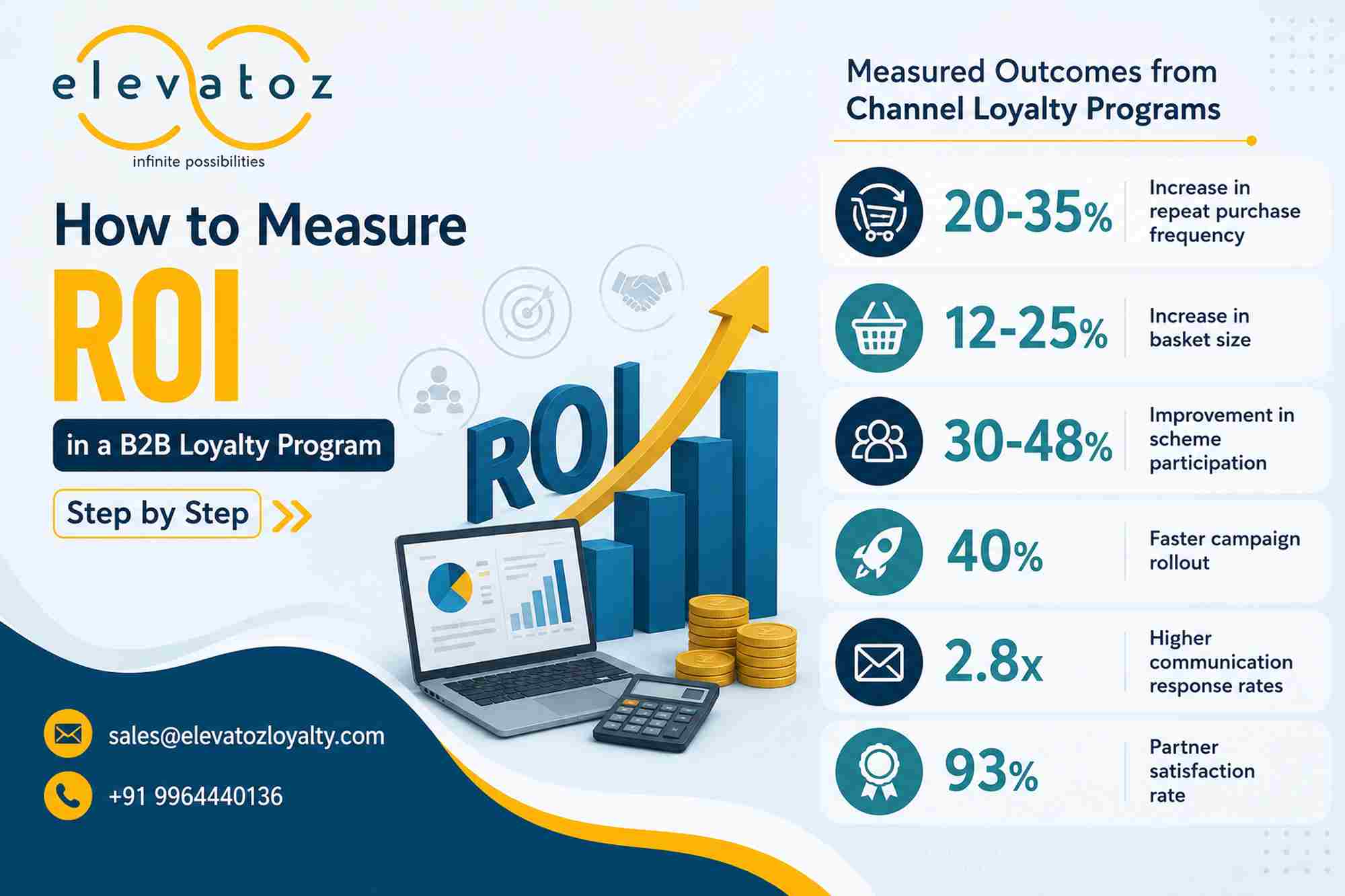
That’s what ROI measurement is really about — not counting how many gift vouchers got redeemed, but understanding whether your investment in channel loyalty is translating into stronger relationships, higher purchase frequency, and real business growth.
First, Understand What ROI Actually Means Here
In a B2B loyalty context, ROI isn’t just a finance exercise. It’s a way of asking: for every rupee spent on dealer incentives, technology, and program management, how much incremental value are we getting back?
The formula itself is simple:
ROI (%) = (Additional Business Value Generated – Total Program Investment) ÷ Total Program Investment × 100
The tricky part isn’t the math — it’s figuring out what “additional business value” actually looks like in your channel. That requires digging into partner behavior, sales patterns, and engagement data.
Step 1: Get Clear on What You’re Actually Trying to Achieve
A loyalty program without defined objectives is essentially a rewards vending machine. It dispenses points, but it doesn’t drive strategy.
Before you can measure ROI, you need to know what winning looks like for your business. A paint manufacturer might care most about repeat orders from active dealers. An auto parts brand might be focused on mechanics recommending their products over competitors. An FMCG company might be chasing better retailer purchase frequency.
Common program objectives include:
- Growing secondary sales
- Improving partner participation and activity rates
- Increasing repeat purchase frequency
- Expanding market reach into new regions
- Reducing dealer and distributor dropout
Without these anchors, your ROI measurement will always feel like guesswork.
Step 2: Track Metrics That Actually Tell You Something
Redemption rate is the metric most teams default to. It’s visible, easy to report, and generally looks positive. But it’s also the least informative metric in the bunch.
Here’s what you should actually be watching:
Sales growth — Compare performance before and after the program launched. Are active participants buying more than they were? Are they buying more than partners who aren’t enrolled?
Active participation — A program with 5,000 registrations and 400 active users isn’t a loyalty program. It’s a sign-up form. Track monthly active partners closely.
Repeat purchase behavior — Loyalty, by definition, means coming back. Rising repeat order rates are one of the clearest signals that your program is working.
Reward redemption patterns — Not just whether partners redeem, but what they redeem for. This tells you what’s actually motivating them.
Partner retention — If fewer dealers are dropping out or switching to competitor brands, your program is doing its job.
Step 3: Account for Every Cost — Not Just the Rewards
This is where many ROI calculations go wrong. Businesses calculate the cost of the rewards and call it the program investment. But that’s a fraction of the real number.
A complete cost picture includes:
- Reward and incentive expenses
- Loyalty platform or software fees
- Technology integration and setup costs
- Communication and campaign budgets
- Administrative and support overhead
- Training and onboarding costs
When you undercount the investment, your ROI looks better than it is — and you make decisions based on a distorted picture.
Step 4: Pay Attention to Secondary Sales
For most manufacturers, primary sales figures — what goes out of your warehouse to distributors — are easy to track. But that’s not where loyalty gets tested. Loyalty gets tested at the counter, when a dealer decides which brand to push.
Secondary sales data tells you what’s actually moving through your channel. It shows you:
- Which dealers are generating the most downstream business
- Which geographies are responding well to the program
- Which products are getting attention at the retail level
- Which partners need more targeted engagement
Without secondary sales visibility, you’re measuring a loyalty program by inputs rather than outcomes.
Step 5: Use Technology to Get a Real-Time View
Spreadsheets can track data. They can’t give you insight.
A modern loyalty management platform gives you live visibility into partner activity, sales performance, incentive redemption, and program health — across hundreds or thousands of partners simultaneously.
The right platform should help you:
- Monitor individual dealer and retailer behavior
- Automate performance tracking and reporting
- Spot disengaged partners before they drop out
- Understand which reward structures are actually driving behavior
- Make data-backed decisions quickly
When your program is running on real-time analytics rather than monthly reports, you can iterate faster and spend smarter.
Step 6: Review Regularly and Keep Improving
A loyalty program that hasn’t changed in two years is out of date. Partner expectations shift. Market conditions evolve. Competition gets smarter.
The brands that consistently get strong ROI from their loyalty programs are the ones that treat it as a living strategy — reviewing data monthly or quarterly, identifying what’s underperforming, and making targeted improvements.
Often, small structural changes — a better reward tier, a more relevant communication cadence, a refined engagement mechanic — deliver more impact than simply increasing the incentive budget.
Why So Many Programs Fall Short
The instinct when a loyalty program underperforms is to increase rewards. More points, bigger prizes. But that rarely fixes the underlying problem.
Most B2B loyalty programs fail because of:
- Poor sales visibility — no one knows what’s actually happening downstream
- Generic rewards — incentives that don’t reflect what partners actually want
- Weak communication — partners forget the program exists between transactions
- Manual tracking — no way to act on insights in time
- No measurement framework — running the program on faith rather than data
The solution isn’t more spending. It’s better structure, better data, and better tools.
The Right Platform Makes a Meaningful Difference
Technology is not just an operational convenience in a loyalty program. It’s a strategic lever.
A well-built B2B loyalty platform does more than distribute rewards. It gives manufacturers full visibility across their dealer and distributor network, automates engagement touchpoints, surfaces performance insights, and helps channel teams make smarter decisions at scale.
Elevatoz Loyalty is built exactly for this — helping manufacturers managing large, complex channel ecosystems move beyond traditional incentive programs with real-time analytics, automated reward management, and complete partner visibility. For brands serious about channel performance, it’s the kind of infrastructure that separates programs that deliver measurable ROI from programs that just feel busy.
Conclusion
Measuring ROI in a B2B loyalty program isn’t about justifying what you’ve spent. It’s about understanding whether your program is genuinely building better channel relationships and driving more business — and knowing exactly where to improve it if it isn’t.
Define your goals clearly. Track the right metrics. Understand your full costs. Follow the data downstream. And use technology that gives you the visibility to act on what you find.
When you approach loyalty that way, it stops being a line item and starts being a competitive advantage.
FAQs
What is ROI in a B2B loyalty program?
ROI in a B2B loyalty program measures the business value generated from your loyalty initiative compared to the total investment made in rewards, technology, and program management.
Which metrics matter most when measuring B2B loyalty program ROI?
The most important B2B loyalty metrics include sales growth, repeat purchase frequency, partner retention, reward redemption patterns, active participation rates, and secondary sales performance.
How does loyalty analytics software help improve B2B loyalty ROI?
Loyalty analytics software provides real-time insights into partner behavior, sales trends, and program performance, helping manufacturers optimize rewards, improve engagement, and maximize return on investment.
Why is secondary sales data important for measuring loyalty program ROI?
Secondary sales data provides visibility into actual product movement through dealers and retailers, helping manufacturers understand whether their loyalty programs are driving genuine channel sales growth.
How often should a company review B2B loyalty program ROI?
Companies should monitor loyalty program performance regularly, with monthly performance tracking and quarterly strategic reviews to identify improvement opportunities and increase program effectiveness.
How can Elevatoz Loyalty help improve B2B loyalty ROI?
Elevatoz Loyalty helps brands improve their B2B loyalty programs through data-driven insights, automated reward management, personalized partner engagement, real-time analytics, and measurable performance tracking.